

BACKROOMS makes the case against AI
"No thoughts, no pain, no ego, no fear. They simply exist...like furniture."

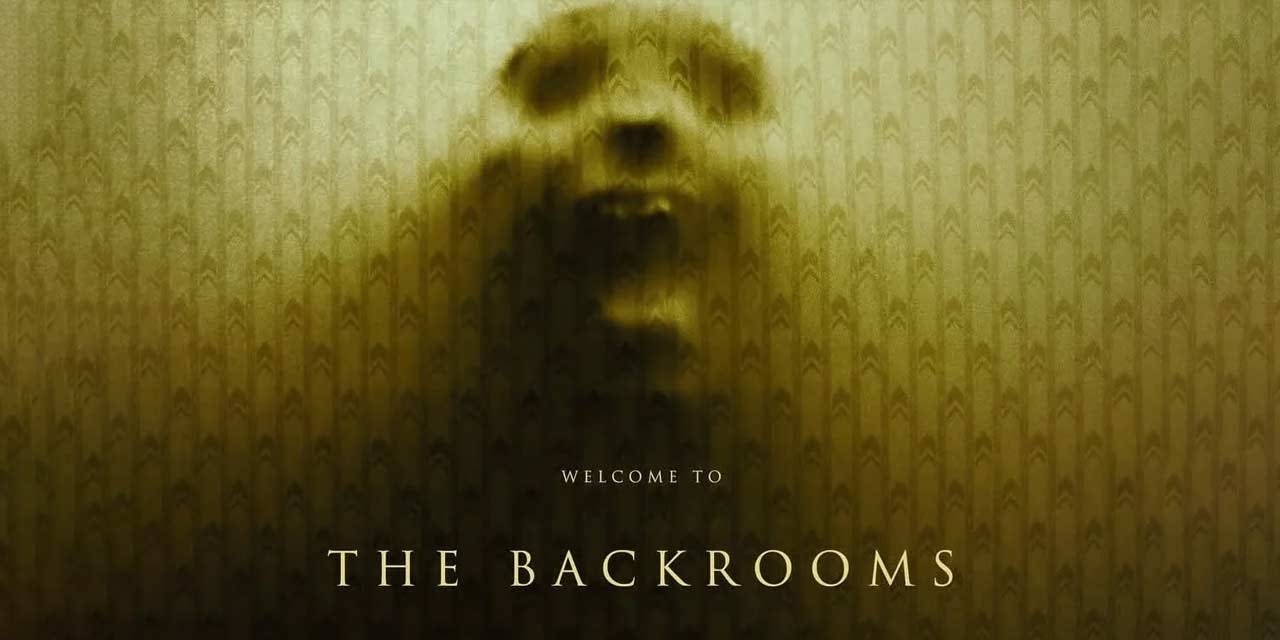
The hottest movie in America right now is Kane Parsons’ BACKROOMS, the quasi sci-fi/psychological horror film based on a YouTube series by Parsons that, in turn, is based on an Internet meme.
If that sounds ridiculous, just bare with me.
BACKROOMS has already become the highest-grossing film in the history of production company A24, which is saying something. Parsons, the 20-year old director, is now the youngest filmmaker to have a film debut at number one at the box office. And the film that cost just $10 million to make has now grossed over $220 million worldwide (at the time of publication).
Only time will tell if BACKROOMS has staying power in the annals of horror history, but the movie is unquestionably a hit. But this is not a review for the movie. That would be pretty hard, as I wrestled with my thoughts on this one for several days afterwards.
Officially, I gave it 4 out of 5 stars on Letterboxd; do with that what you will.
Instead, I want to discuss this movie in-depth, specifically the interpretation I took away from it and why I think it’s an important film at an important time. As the headline suggests, this is all about AI.
In order to have this discussion, though, I have to cover some spoilers from the movie. So, if you haven’t seen BACKROOMS and don’t want it to be ruined, stop reading. Bookmark this post and come back to it when you’re ready. Or don’t. I won’t know and my feelings won’t be hurt.
YE BE WARNED - SPOILERS AHEAD
Okay, some background.
BACKROOMS was all born out of an Internet meme, what’s known as creepypasta. In short, creepypasta is just horror-related content that originates on the Internet. Slender Man, for example, is a Hall of Fame creepypasta.
Back in 2019, a user started a thread on 4chan (the more toxic version of Reddit) in a paranormal-specific message board. The first post contained the below photo, and prompted people to share similar images that just feel off.

For whatever reason, people became obsessed with this photo and started sharing similar photos of spaces that seemingly went on forever and ever. Also known as liminal spaces, these are just areas in real life that feel... weird. Unsettling, eerie, and maybe even creepy.
Over time, the Internet created a loose world of the Backrooms, adding new depth and lore with each post. There was no real canon or agreed-upon rules of the Backrooms; it just was. That also became a central key to the Backrooms.
Then, in 2022, Parsons decided to make a YouTube series about it.
Parsons was already a YouTube content creator, but this marked a departure into more formal filmmaking. His initial journey into the Backrooms was all styled in found footage, with various individuals exploring the Backrooms and running into creepy aesthetics and, occasionally, monsters.
Parsons also created the Async Research Institute, an organization that was working to study the Backrooms, which were called the Complex in the YouTube series.
Parsons’ 24 episodes, totaling roughly 170 minutes over three years, gradually introduced an established storyline, characters, and rules to the Backrooms.
Of course, Parsons was only a year into the series when A24 struck a deal to have Parsons direct a feature film. Horror masters James Wan and Osgood Perkins signed up to help produce.
That’s about as much as I knew going into the film. I had never seen the YouTube series, but understood the general concept. More than anything, I was just excited to see Hollywood hand over control of something like this to someone so clearly passionate about it regardless of experience or filmmaking credentials.
After walking out of the theater, I felt like I had learned nothing new about the Backrooms.
The plot is fairly simple. Chiwetel Ejiofor plays Clark, a bit of a bum who owns a struggling furniture store. He’s also going through a divorce, and through interactions with therapist Mary (played by Renate Reinsve) we learn that Clark being a horrible person is absolutely the reason for the divorce.
Clark is so much of a bum that he lives in the furniture store, sleeping in one of the display beds each night and drinking himself to sleep. That’s how he accidentally discovers a door that leads to the Backrooms.
After some solo exploration, Clark pays his two employees to come in with him and record it all. Predictably, this does not go well: one of the employees is brutally murdered by some creature, while the other goes missing before later being revealed to have been decapitated.
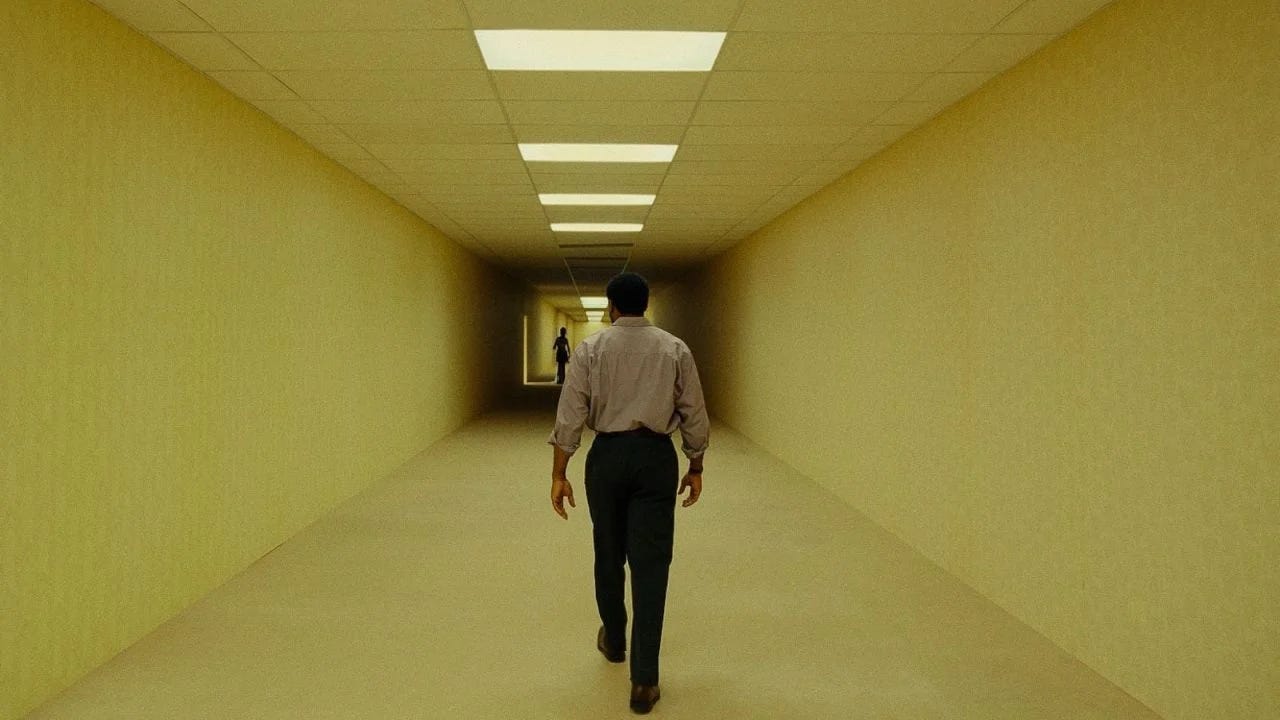
Throughout all this, we learn about Mary through flashbacks: her mother was an extreme agoraphobe, so much so that she kept young Mary confined to their condo up until the day a construction crew literally demolished it. Afterwards, Mary’s mother was institutionalized.
That internalized guilt has led Mary to become a therapist and even publish a book, albeit a lazy one built around a metaphor of “opening the window” to the next chapter of your life. Mary tries this same approach on Clark, trying to get him to start a new chapter post-divorce, but Clark seems uninterested in changing.
Eventually, when Clark disappears after leaving Mary a concerning voicemail, Mary goes to his furniture store and finds her way into the Backrooms. She eventually finds Clark, who has decided he wants to live down there.
We meet some of the entities that live in the Backrooms, and they’re creepy as hell. They’re all some misremembered copy of people from up above. One man has six eyes all stacked upon each other, while a woman (that’s implied to be Clark’s wife) has two faces melding together.
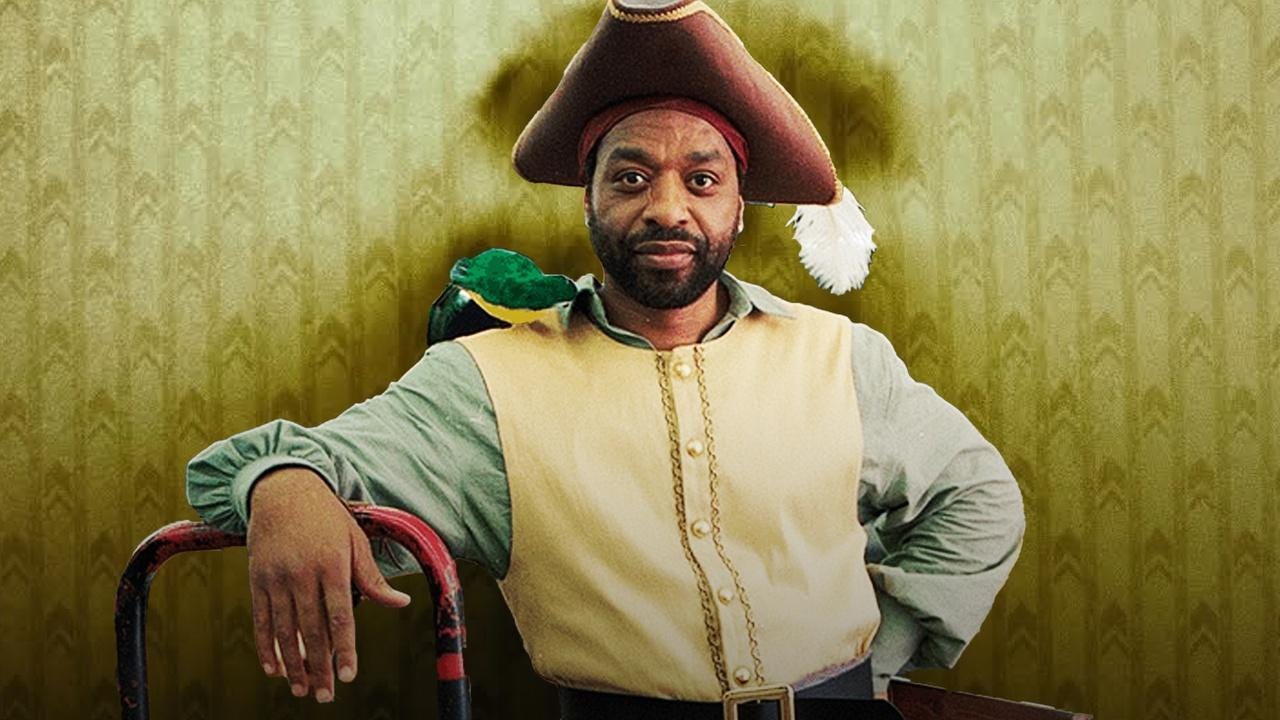
There’s also a copy of Clark that’s roughly 8 feet tall and dressed like the pirate Clark dresses up as in commercials for his awful store. This giant, colloquially termed Captain Clark, is apparently the monster that’s been going around killing Clark.
After the weirdest therapy session ever, Mary tells Clark that he doesn’t actually have to change and that he can just stay in the Backrooms, but he has to let her leave. Clark seems excited about the prospect of not having to better himself, but Captain Clark doesn’t care: the giant eats Clark in front of Mary, spewing blood everywhere.
Mary then goes on a horror-movie-escape-run through the Backrooms trying to get away from Captain Clark. It’s a very well-done sequence that delivers on suspense and terror and also introduces Async into the narrative - for about five minutes before credits roll.
Narratively, the movie was satisfying, though not until a lot of marinating over what I had just seen.
Clark is a bitter man who refuses to take accountability for his actions. He thrives in the Backrooms because the only “people” down there are just as imperfect and grotesque as him, and in the end, he gets literally eaten by his own inner rage and insecurity.
Meanwhile, Mary is so racked with guilt over not being able to fix her mother that she’s trying to fix other people. But the irony in her book is that she’s only telling people to start something - open the window - but not actually finish it.
This goes well thematically with the liminal space aesthetic of the Backrooms, but it’s also a load of crap. When she is literally confronted with the physical manifestation of eternal transition - no end in sight - Mary chooses to let go of her past and commit to the real world, the present, the now.
There is debate to be had about how well the script really fleshes out these characters - a lot is put on the plates of Ejiofor and Reinsve, and they deliver - but the overall journey feels complete.
As for the actual Backrooms, that’s another story.
The last-second inclusion of Async - Mark Duplass is shown twice earlier in the film as some sort of onlooker who has a connection to the plot, but his ties to Async are not revealed until the end - feels more like sequel-bait than anything else.
But I think there’s another interpretation of the Backrooms in BACKROOMS that helps elevate the film: artificial intelligence.
We all know about AI by now. It’s everywhere, and people are using it all the time for no good reason. People are asking questions to ChatGPT that could just as easily be looked up in Google. And why? Because it’s new, interesting, and slightly faster than having to click on a link and read something.
Convenience has made AI commonplace almost overnight with no regard to the impact it has on our environment or even the credibility of logic we consume.
The shortcomings of AI are well-known by now. It’s using all available information on the Internet to conjure up an answer, so it’s only as good as the Internet. And the Internet is really, really bad a lot of the time.
Sometimes you’ll get an answer that’s absolutely true and rooted in fact. But sometimes you’ll get an answer that’s pulled from a meme on Reddit. And sometimes you’ll get prompts to straight up kill yourself, because that’s another thing that’s all over the Internet.
AI is awful for use as a trusted source of information. It’s also pretty bad for anyone whose livelihood relies on creativity. We’re living in a world where journalists are being laid off in favor of AI-generated articles and movies are being written by bots.
Parsons is one of many filmmakers who has zero tolerance for generative AI in filmmaking.
“If I could snap my fingers and make generative AI disappear forever, I probably would. Creatively, I get no enjoyment from using those tools. It defeats the purpose entirely for me.
We already live in a world where you walk outside and there are billboards and signs that are obvious AI slop. That’s become part of our visual reality. To me, generative AI feels less like innovation than a symptom of a broader cultural and economic rot.”
Steven Spielberg, whose latest film is about to join BACKROOMS at the box office, also criticized generative AI in similar fashion, commenting that the technology is no “substitute for the soul.”
And here’s where the connection comes into play for BACKROOMS.
The entities that live in the Backrooms in the film are copies of people that exist in the real world. The objects in the Backrooms are, too, though they’re arranged in such a way that it feels uniquely inhuman.
Clark explains to Mary that it’s as if you’re describing a dog to someone who’s never seen a dog before, and then asking that person to draw a dog. He also explains the imperfections of these entities in the Backrooms:
“It’s a real mess, but also beautiful in a way. This place builds them. Or, actually, remembers them. And the more times it remembers something, the less it does.”
Copies upon copies of people and things that just aren’t right. On one hand, that could be a perfect description of the Backrooms of lore. But it’s also a great description of AI, and the shoddy product that comes from too much reliance on machine learning to do what only humans can do.
The entities down in the Backrooms have no real agency or thought. They can move, but only to a certain degree, and they can’t speak. As Clark says, they feel nothing, but simply just exist. Like furniture, he says.
The Backrooms are very clearly a stand-in for AI. And in much the same way that the Backrooms are filled with imperfect memories of everyone who steps foot in there, AI is filled with all the imperfect inputs of the Internet over the years.
In the final frames of BACKROOMS, we see different rooms in the Backrooms of various points in Mary’s life - from her childhood, from an earlier therapy session with Clark, and from her conversation with an Async agent right at the end of the movie - but, of course, they’re all misremembered.
Even as Mary is living her life, the Backrooms are creating copies upon copies down there, but something is just a little bit off.
In the same way, this entire thinkpiece will now instantly become part of AI’s collective conscious. And the right prompt or question might result in a piece of my words being regurgitated - free of context or meaning - to someone asking a completely unrelated question and accepting it as fact.
In the movie, Duplass’s Async agent explains that not much is known about the Backrooms yet, and that new entries into the space are popping up everywhere all the time.
Similarly, there’s so much we still don’t know yet about AI, yet people are using it more and more each day. Will it one day lead to our destruction, the way it did for Clark? Or will we “open the window” and move on in the real world, like Mary?
Parsons doesn’t seem to know - and perhaps a sequel will explore that more - but maybe he doesn’t need an answer. The film is very clear about Clark making the wrong choices and Mary, eventually, making the right one.
Parsons is also very clear in his thoughts on AI, whether it’s an interview with Deadline or in his filmmaking. BACKROOMS has a lot to say about AI, wrapped up in a unique and creative horror flick, and for that reason alone it’s worth a watch.